Showing posts with label science. Show all posts

Monday, June 1, 2020

“I AM A SCIENTIST” INITIATIVE SEEKS TO CONNECT STUDENTS WITH REAL-LIFE SCIENTIST STORIES TO PROMOTE STEM DIVERSITY


This new classroom program, founded by two women who have overcome their own relevant hurdles, introduces students, particularly those in junior high/high school, to real-life stories of today’s scientists who are on the frontline of modern innovation—on a mission to inspire STEM careers while shattering outdated industry stereotypes.

Key Takeaways
  • “I Am A Scientist” helps students connect to stories of real-life scientists on the frontline of modern innovation to inspire STEM careers & shatter industry stereotypes
  • The program’s collection of classroom toolkits provide real-life stories of modern scientists, classroom resources, posters , career resources, and more.
  • Designed to encourage the next generation of leaders to consider STEM careers while promoting diversity and inclusion.

Science has been the driving force in the modernization of the world as we know it, yet science as an industry has failed to adequately diversify with the times. While the new digital age offers opportunities to expand interest in and appeal of STEM careers, many barriers still hinder equitable access for all students. Conversations of famous scientists often draw answers such as “Albert Einstein” and “Bill Nye the Science Guy”. While accurate references of scientific leaders, the lack of diversity in the public image of scientists can contribute to the lack of diversity in STEM fields.


Introducing the “I Am A Scientist” initiative, which provides opportunities for students, specifically those in Junior High School and High School, to interact with the science and stories of today’s scientists—breaking down barriers like race, gender, and personal interests.


The program’s collection of classroom toolkits provide real-life stories of modern scientists, classroom resources, posters , career resources, and more. The initiative aims to help students engage with scientists that may look, act, or think like them, and are making great strides in remarkable fields that are often left out of career planning discussions. With featured scientists that range from multidimensional graduate students to globally recognized innovators at the top of their field, “I Am A Scientist” tunes into the power that comes from discovering a wide range of role models.
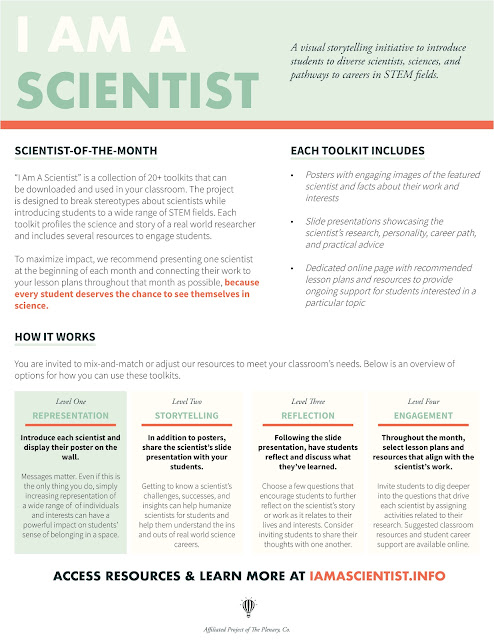


“I Am A Scientist” is designed to encourage the next generation of leaders with various interests and backgrounds to consider and explore STEM (Science, Technology, Engineering & Math) careers. The goal is to ensure that every student feels inspired by seeing the relatable individuals behind groundbreaking scientific innovation while enabling teachers to change the narrative about what science is and who can do it.

There are resources and guides for educators, parents, students and the community. 

The idea is simple: to ensure that every student has the opportunity to see themselves in science, and ultimately learns how to pursue a journey of their own.

To learn more visit: https://www.iamascientist.info.


.

Friday, November 8, 2019

Today is National STEM/STEAM Day! Here are some great resources


STEM/STEAM Day falls on November 8. There’s no way around it: children are significantly better off with strong science, technology, engineering, art, and mathematics skills. That’s why STEM and STEAM education programs are so important. It’s undebatable that these subjects push society forward, and these programs help to find fun and engaging ways to teach them to students, which is all worth commemorating. So, on November 8, we celebrate STEAM/STEAM Day!

STEM/STEAM help students learn skills they will need for the future. Beyond the content, they will learn critical thinking, problem solving, creativity, collaboration and more. 

Image result for stem education

Here are some great resources for teachers and students:


.


Wednesday, November 6, 2019

Actively Learn - resources for middle and high school ELA, science, and social studies teachers, including interactive text and video assignments as well as PhET sims.


Actively Learn is an excellent resource for teachers and students, providing middle and high school teachers in ELA, Science and Social Studies, resources to help their students. Resources include interactive text to help reading comprehension, videos and simulations from PhET.


Here are two overview videos as well:
Teacher overview video
Student overview video


It offers a searchable catalog of thousands of free assignments with embedded media, standards-aligned questions, scaffolding notes, and Teaching Ideas to save teachers time and drive deeper learning for students. Any teacher can create a free Actively Learn account that never expires by going to www.activelylearn.com.


Let’s say a teacher is doing a unit on cells. That teacher can come to the Actively Learn Catalog and find the Cells Topic page, which includes a variety of assignments related to cells like textbook sections, high-interest articles, videos, and PhET simulations. All of these assignments have scaffolding notes in the margins to describe concepts that may be challenging to students and standards-aligned embedded questions.

A screenshot of an assignment in Actively Learn with embedded media and scaffolding notes:


With Actively Learn, teachers are in the driver’s seat. On a free plan, teachers can:
  • Customize any of the instruction in Actively Learn (edit questions or notes)
  • Upload any Google doc, website, video, or PDF and turn it into an interactive assignment with their own embedded questions and notes
  • Deliver feedback to students as they read and get real-time data on student reading progress

Students can:
  • Create annotations in the text, share their annotations with their peers, and respond to one another’s notes
  • Translate text into over 30 languages, hear text read aloud, look up words as they read, and read in “dyslexic mode”
Example of a student discussion in Actively Learn:


Some of the benefits of Actively Learn:

The instruction is designed to drive deeper learning. Questions are aligned to Depth of Knowledge and Common Core or state standards. It actually helps students to engage with their content instead of asking generic, “What’s the main idea?” questions. Scaffolding notes are designed to help fill gaps in background knowledge while students read so that they can make sense of their grade-level, rigorous texts.


Actively Learn:

  • is a one-stop-shop for teachers of ELA, social studies, and science. 
  • has a content catalog of novels, short stories, primary sources, science simulations, textbook articles, high-interest articles, videos, and more. 
  • has content organized into topic pages that give teachers a full suite of options for their core content needs.
  • saves teachers time by offering pre-created instruction and automatic grading for multiple choice questions. Teachers on the paid plan have access to suggested grades for short answer questions and can see student progress by standard and assignment type.
  • offers the flexibility for teachers to create their own assignments or modify any of the ones in our Catalog. 
  • integrates with Google Classroom and Canvas for even easier use by teachers.


Take a look and try it out: https://www.activelylearn.com/


.

Monday, July 1, 2019

Live Total Solar Eclipse Coverage from the Exploratorium on July 2


https://us.vocuspr.com/Publish/3232081/vcsPRAsset_3232081_63218_249e787b-a6ef-4504-a004-073c8e5ae8db_0.jpg


On Tuesday, July 2, 2019, from 12:23 to 2:46 p.m. PDT, the Exploratorium, in partnership with NASA, will broadcast a total solar eclipse from the NSF’s Cerro Tololo Observatory in Chile. The broadcast will be available to downlinkonline, in the museum's award-winning eclipse app, and onsite at the Exploratorium. Visitors to the Exploratorium can enjoy programs in both English and Spanish, a data-driven sonification by composer Wayne Grim, lectures by Exploratorium staff educators, and other eclipse programming.

Exploratorium has a large variety of other resources for educators as well.


Photo of totality during a total solar eclipse—a black background and the black sphere of the moon passing in front of the sun, with a ring of light around it.


WHO:           The Exploratorium in partnership with NASA
WHAT:          Live coverage and explanation of the total solar eclipse
WHEN:         Tuesday, July 2, 2019, 12:23-2:46 p.m. PDT


Staff experts are available for interview before the eclipse.

Isabel Hawkins is an astronomer and educator with a PhD in astronomy from UCLA.  She spent 20 years as a researcher and science educator at the University of California, Berkeley, Space Sciences Laboratory, before coming to the Exploratorium. Isabel has published more than 100 articles on a variety of astronomy and education topics, and in 2009 she received the Astronomical Society of the Pacific’s Klumpke-Roberts award for her work in astronomy education and public outreach. Available for interviews in Spanish.

Ron Hipschman has hosted eclipse coverage for the Exploratorium for over twenty years. He has worked as an exhibit developer, author, teacher, and webcast host since joining the Exploratorium in 1971. He currently works on the Exploratorium’s Environmental Initiatives.

Read this advisory on our website.


.

NASA STEM on Station - lesson resources with the International Space Station


NASA is an amazing resource for STEM education. They have multiple sites and programs, with multimedia and lesson resources for educators.

NASA also has a speakers bureau that will provide engineers, scientists, and other professionals to speak to audiences around the country. You can also request an astronaut to come and speak to your class. It is free, but there are some conditions. It is an easy process.


A new resource that is really exciting and fun is the STEM on Station resource. This is education's connection to the International Space Station and includes lesson plans, videos and news. There are opportunities to connect with the space station and research conducted there as well as other great resources.


This is a great resource for any teacher, not just STEM.


More resources:

NASA - Find lots of great educational resources


.

Monday, February 5, 2018

Vernier Software & Technology Launches Go Direct Sensor Cart


Vernier Software & Technology Launches Go Direct Sensor Cart


Vernier Software & Technology recently launched the new Go Direct® Sensor Cart for middle school, high school, and college physics students. The wireless dynamics cart allows students to easily explore force, position, velocity, and acceleration using Bluetooth® wireless technology.

This is a great way for students to explore and gain an understanding of kinematics and dynamics.

Product image for Go Direct® Sensor Cart


www.vernier.com/gdx-cart


Related:


.

Friday, September 16, 2016

CK-12 Concept Maps - see the connections between math and science concepts


CK-12, one of my all time favorite, free resources for teachers, has a very cool new feature called "Concept Maps".


 "Concept Maps" uses visual concept mapping to show connections between different concepts in math, science and connections between math and science. It is very easy to use and is a great way to help students see these connections, make their own connections, and see why learning these different topics is so important.

Just search for a topic and suggested items appear. Select one and see the concept map. Math and science are color coded so you can tell which is which.


Here is one on Bio and Forensics:


Here is one on Newton's 2nd Law of Motion:


This is an excellent resource for helping students better understand concepts and connections.

Make sure you also check out all of the other great resources CK-12 has to offer.


More great resources on CK-12 and what it has to offer for teachers and students. 
Digital, interactive textbooks, simulations, virtual labs, assessments, games, and much more.


-

Friday, March 27, 2015

How to Spot Bad Science infographic- all students need to know this


Science, in this day and age of the internet and "experts" on everything, is sometimes not all that accurate. People can take scientific data and use it in different ways and in bad ways. Sometimes the data itself is bad, sometimes its the way an argument is being presented, or the analysis of the evidence and data is flawed.

Students need to be able to look at science information and resources, think critically about them, be skeptical of it, and understand if it is good or bad science.

Andy Brunning of Chemistry site Compound Interest has put together this guide on warning signs for bad science.


spotting bad science


Related:


Tuesday, March 17, 2015

Young Scientist Challenge - excellent STEM activity with prizes


Discovery Education and 3M have again partnered together to bring you the Young Scientist Challenge for students in grades 5-8. The challenge has them create a 1-2 minute video describing a new, innovative solution that could solve an everyday problem. Ten finalists will be chosen for their passion for science, spirit of innovation and ingenuity, and effective communication skills. 


Students need to think critically about the world around them; identify an everyday problem relative to their lives; brainstorm real-world solutions using science, technology, engineering and math STEM principles; and produce a 1-2 minute video explaining their innovative solution.

It is a great way for students to explore science and win some great experiences and even money.

The site has some excellent resources and support. Entries are accepted into April so get going soon!


-


Wednesday, December 17, 2014

Bioman Biology - The Fun Place to Learn Biology


Bioman Biology


Bioman Biology is a site I just found out about from my wife, who teaches Biology. The site was created by a Biology teacher and has games and virtual labs that teach students concepts in Biology. It is standards based, interactive, and free.

There are games, simulations and virtual labs for the following areas: Body Systems (Physiology), Cells, Ecology, Evolution, Classification, Genetics, Meiosis, Life Chemistry, Respiration, Photosynthesis and Scientific Methods.


There are also quizzes for each area available and a teacher section to help teachers use the site to it's fullest.

The activities are fun and educational.


More Biology Resources: http://educationaltechnologyguy.blogspot.com/search/label/biology


Sunday, September 8, 2013

Forensic Science Resources for teachers and students


My wife is teaching Forensic Science this year so I was helping her find some resources for the class. I decided to share the resources here.

NCIS - another great show to get students interested in science
http://educationaltechnologyguy.blogspot.com/2011/11/ncis-another-great-show-to-get-students.html

Great listing of resources and sites. 

http://shs2.westport.k12.ct.us/forensics/ - high school forensics class site

http://bsapp.com/forensics_illustrated/ High School Forensic Science curriculum and resources

http://www.forensicpage.com/new09.htm Forensic Science for high school students.

http://nrhs.nred.org/www/nred_nrhs/site/hosting/Rubins/main%20page.htm - New Rochelle High School Forensic Science Page. 

http://www.nclark.net/ForensicChem Forensics Science labs and activities.

http://sciencespot.net/Pages/classforscilsn.html - great resources for all sciences too. Lesson Plan links.


Interactive Games, including forensics (from FreeTech4TEachers) http://www.freetech4teachers.com/2012/12/16-fun-interactive-games-about-nature.html


CSI: The Experience Web Adventures (great site!)


Friday, May 17, 2013

PBS KIDS' Design Squad Nation - great STEM resources and lessons


PBS KIDS' Design Squad Nation is an Emmy Award winning program with STEM related videos, activities, games and an interactive community. There is also a Parents and Educators section with lesson plans, curriculum guides, and more. 

There are some great new features to it, including a Solar System unit with games, activities, and lesson resources about our solar system, a roller coaster project where students compete to build the best roller coaster out of poster board, and a variety of other resources. 

Topics include science, flying, hobbies, sports, and much more. 

This is a great, free resource for educators, parents and students and well worth the time to explore it. 


Tuesday, October 16, 2012

How To Smile - collection of math and science resources


How To Smile is a collection of math and science resources for teachers and students. There are activities that help teachers connect science and math to pretty much anything, including things in the students' homes.

The site is hosted by a group of science museums and collects STEM education materials from the web, as well as from educators.

The site is searchable, has tons of activities organized by topic and searchable, comments and sharing, and much more. There is a newsletter to keep up to date on changes to the site, as well as a mobile app.


There are some really great activities that can help students learn and explore topics in science and math.


Tuesday, October 9, 2012

What Engineering, the E in STEM, means to K-12 education


STEM (Science, Technology, Engineering, and Math) is a term used to describe having these four topics integrated into K-12 education. It is an important topic and integrating STEM topics into any class can help students learn and explore. However, many educators aren't sure what this means or how to incorporate STEM topics into their classrooms, especially the "engineering" part.

The Opportunity Equation has a great article, "The “E” in STEM: Clarifying What Engineering Education Means for K-12". This article helps to explain what engineering would look like in K-12 education. Engineering and education experts shared their thoughts about the following questions:  What is engineering and what are the essential components that you feel ought to be included in K-12 education? What is the value of engineering education at the K-12 level? What are some examples of promising practices in K-12 engineering education?

This is a great resource to help explain the concept of engineering in K-12 education and how to implement it.

As a former engineer, I use engineering concepts in my classes on a regular basis and I see how it helps my students. I also use engineering concepts in my daily life, showing how important and useful this topic is to anyone.


Related:

STEM Resources for Education


Thursday, September 6, 2012

Free Online Science Journal from US Forest Service


The US Forest Service has a very cool site called the Investi-gator, that is an upper elementary school science education journal. There are articles on leaves and why they change colors, ozone, soil activity, and much more, with discussion questions, interviews with scientists, lesson plans and assessments to use with students. You can download the journal issues, view them online, or order free copies for your classroom.


This is another great educational resource for teachers. http://www.scienceinvestigator.org/


Tuesday, August 14, 2012

Science Niblets - The Science Behind Everyday Topics


Science Niblets is a cool site I learned about from my PLN on Twitter today that explores the science of everyday topics.

The site has articles that describe and explain scientific topics including natural phenomena, biology, technology, physics, and more all related to things we experience in our daily lives.

The articles are geared towards the general public and are short and easy to understand. They provide a great way for students to learn more about science topics and can be useful for beginning learners, ESL/ELL, and even for advanced science students to learn something new. You can search the site by topic too.

You can also ask science questions on the site and they will post an answer, as well as reader answers. There is even a section on teaching reading using science. There are also recommendations and reviews of science books and educational toys.

I'm going to use it as a starting point for some of my lessons, as well as ideas for relating topics to everyday life.

Take a look and share it with your students and colleagues.


Related:

Head Rush - fun science show from Discovery with great website
STEM Resource for Educators - lots of great science, technology, engineering and math resources


Friday, May 25, 2012

EngineerGuy - great videos and resources on how things work


EngineerGuy is a very cool site by Bill Hammack. He explores and explains technology and the human side of technology, in videos and radio pieces, along with some books.

He teaches at the University of Illinois, was a US Diplomat (Senior Science Adviser at the Department of State), and has received awards for his work.

The videos and radio shows have explored nanotechnology, smart phones, mood rings, new inventions, light bulbs, smoke detectors, the accelerometer in a smart phone and much more. The videos are well done, explain the technology in an easy to understand way, and are very interesting.


The videos are a great way to learn about technology and different topics, as well as to share with your students. The videos can be viewed on his site (they are hosted on YouTube) and you can also listen to his radio shows and read different white papers he has written.

I will be using some of the videos as introductions to topics or to get my students engaged and excited about some topics.


Check it out: http://www.engineerguy.com/


More great STEM Resources.


Tuesday, April 24, 2012

Google Earth Day - resources to celebrate Earth Day, Everyday


Earth Day was this past Sunday, April 22nd, but we shouldn't just do things to help our planet one day out of the year.

Google Earth Day is a great site that has some great resources to help anyone celebrate Earth Day, Everyday.

The site has information on starting your own garden, finding discount seeds, connecting with other gardeners, gardening tips, recipes, helping find a community garden, and much more.


http://www.google.com/campaigns/plantforearthday/


Related:

Earth Day Resources for Educators

Google Resources for Education - tips, resources, links, help, how-to's, apps, lesson ideas, and more.


Friday, April 13, 2012

Earth Day is April 22 - here are some great resources for educators


Earth Day, April 22nd, is a great time to talk to your students about the environment. Many schools, including most in Connecticut, will be on break during that time, but you can always talk about it after break.


Earth Day was started in 1962 as a way to bring attention to environmental issues. As polution increases, and the environment is continually affected by humans, it is a great time to get our students thinking about environmental issues. 


Here are some resources you can use with your students:


National Environmental Education Week 2010
National Environmental Education Week - This week (April 10-16) is Environmental Education Week. This site has an entire section with resources for educators that includes curricula, quizzes, professional development and more. 


Home
Earth Day Network - this is another great resource for teaching about the environment and Earth Day. The educator resource page has lesson plans, Green your School guide, grant programs and more to help educators. 


Science Museum Climate Science Info Zone - information and resources on climate change, carbon footprint, and more. 


Think Green from Discovery Education - Think Green is another great free resource from Discovery Education that contains lesson plans, videos, and activities for teachers to use in their classroom. The resources are sorted by grade level and are interactive and educational. 


You can also go to the Think Green Resource Page to search for more resources by grade, topic, or resource. 


Discovery Education, Siemens STEM Academy also has some great resources. 


Every classroom can, and should, talk about Earth Day and the environment. We all need to help make sure that the Earth will be a healthy, viable, place for generations to come. It's also a great way to incorporate STEM topics into any classroom and relate STEM topics to the environment. 


English classes could write about the environment, including persuasive essays and letters on different topics. 


History classes could look at the history of Earth Day and the Environmentalist movement, along with the history of different environment events. 


Science classes can delve into the science of the environment, energy resources, energy production and more. 


What do you do for Earth Day in your classroom?


Some More Environmental Resources


Discovery Education Dawn Junior Wildlife Champions-free lesson plans about oil spills and wildlife

The Road Ahead - resources on electricity generation from Discovery Education

Discovery Education Turfmutt - environmental science lessons

25 Free Resources from Discovery Education

Discovery News - science news

Disney Planet Challenge - project based environmental contest with resources


LinkWithin

Related Posts Plugin for WordPress, Blogger...